Semester 2
Entry One – Sketching Tasks

Today we were introduced more into what prototyping is like. Not only we were given a lot of information but also a pair of exercises to practice sketching, which I am very familiar with. However, today’s exercise regarding sketching gave me an important lesson on another area.
On the first task we were asked to draw an upside down face while closing out eyes a little, this way we could focus on the main, more primal aspects of the picture instead of the face itself, but it is the second task I want to focus on. The second task was to quickly draw five panels for a storyboard showcasing our morning routine in about six minutes, which to me seemed simple enough as I am familiar with making panels for comics. To my surprise, I failed to complete the task. While doing it I had to stop and think about what I should show and I spent some time trying to make it look the way I imagined it to, this resulted in me trying to make panels look more detailed than necessary, to the point of me remaking one of the panels because I did not like the result, thus loosing more time, ultimately ending my storyboard at three out of the requested five panels.
Out of this exercise I have now seen that over-complicating designs could give as a result an uncompleted pieces of work. Sketches should be dirtier, messier and simpler than what I am used to work on independently. My time should be instead spent on trying as many alternatives as possible, as said in today’s class «Usually if we have two sweaters, we try one and we like it we never actually try on the second one. But we should».
Entry Two – Woodworking Part One
Today we started a project I am really excited about. I have done woodworking before but for very brief moments and usually for school purposes, but today’s task is to join a competition with a set of rules to be followed. We were going to do a stool competition!
My teammates for this project were also some of my teammates from a previous group project, this made the act of taking decisions, fulfilling tasks and mostly communication much easier than when we first started working in the previous semester. I believe this was due to our experience working together and the trust we built upon collaborating.
For starters, we started by sketching our ideas. I immediately noticed the impact of the previous class regarding sketching. I decided to put that teaching into practice and made quick and dirty sketches, as many as I could. It worked wonders as we were able to sketch many ideas in no time. We debated for a while on what design would be better, and we got hands onto it.
While working I was told a very nice phrase that I kept on my mind during the entirety of the day, which was «Measure twice, cut once». This was said by one of my teammates who wanted to be very careful with the material we would work with as both our materials and time were limited. I will probably come back to this philosophy of being extra careful not to make any mistakes often during any prototyping class, or for the entirety of the course maybe.
By the end we had an unexpected turn of events which ended the day with a bit of stress, as when we were about to leave every piece of wood we had worked on during the day we noticed that we had to get a sign for our material not for it to be taken by accident. In a rush we tried to do this before the workshop closed we grabbed all of the wood pieces at once, which resulted in one of the pieces falling on the ground and breaking in two. This was not fatal however as it was meant to be a minor support piece for the stool, so it was not really too bad to have had lost that one piece, but it reminded me of another phrase, one that I was often told as a child, being it «Dress slowly, specially if you are in a hurry». It seems as if today was not only helpful for what it intended to be, just a class to learn the use of the workshop and to work using limited resources; but it also ended up refreshing some important mentalities that will help me over the longevity of this course.

Quick and dirty sketches 
First sketches + measurements 
More sketches 
Final sketch 
Final sketch (measurements added) 
Measure twice, cut once 
Johan cutting wood 
Viktor cutting wood 
Incident
Entry Three – Retaking Arduino
Today I re-visited the fun that is playing with an Arduino. I say re-visited because I have already taken other Arduino classes in which we were teached the basics of what can be done with it, but it is never a bad thing to go back to the basics and refresh your mind on the usage of an electronic you will use in the next couple of months.
Starting with connecting LEDs to finally making a Knight Rider like effect made up for a fun, entertaining and overall, useful class that got me looking forward to the next one.
Extra: After class we were visited by the TAs, who kindly showed the Design Lab to us new students. It was mostly them letting us know that they will be there when we need them. However, the best part came by the end when almost everybody was leaving, when the TAs asked us to test their newest project, which was a sort of variant of the game «Twister». Both my teammate Johan and I decided to participate in three rounds of this game to then give the TAs feedback on their project by suggesting ideas and telling them our overall opinion.
Entry Four – Woodworking Part Two
Today we finalized our previously mentioned project on making a wooden stool. This day however was far different from the first, as we had very little time to polish the last details before attaching all parts of our stool together to test out if it could hold us standing over it. Both my teammates and I quickly jumped into action. We smoothed the wood pieces that were still rough, aligned all parts so we could attach them easily, softened the pointy edges to avoid possible accidents and added two holding holes, one on each side of the stool.
With only thirty minutes left we attached all pieces to make the stool stable, smoothed the bottom part to add more stability and finally tested it out. We were very happy to see that we had fulfilled our purposes for the task and it successfully held up one of us standing on top of it without being damaged. This was a very tense moment as we had lost one of our strength pieces on the past week. When the moment for voting came we ended up with a good amount of 7 points. Considering the top score reached was 8 we were actually very happy. Even if we had a simple design we had accomplished our goal, and just like learned before, it would be much better to finish and fulfill the task than attempting to make it too good to be even finished in time.
By the end of the day I took the stool home, as I am writing this i am using it to hold my feet while sitting on the computer.

Viktor cutting the holes 
Drilling the wood 
Viktor having fun 
Viktor finishing the holes 
Cutting the wood 
Johan standing on the stool 
Stand Proud
Entry Five – Arduino Basics and New Tools
Today we started up with new topics on Arduino. I was already excited about going back to the basics and maybe learn something new. Jumping from nobs to force resistors and finally a piezo buzzer, the class was a non stop of fun exercises that impulsed me to think about what can it be used when it comes to prototyping.
It was great to also see an implementation of how we could make a very basic design for a great prototype. The door-knocking-lock prototype helped me visualize how a great device can be displayed by not focusing too much on aesthetics but instead on functionality. As I tend to focus on aesthetics over functionality most of the time, I found it surprising how little attention I had put on the looks of the prototype shown in the video. I believe it was because that prototype was not supposed to look good, but instead work nicely and focus only in delivering a nice functionality.
Having this in mind while doing a prototype using an Arduino board may be the best choice to deliver a good prototype.
Entry Six – Video Prototyping
Today we reviewed the videos each group made for different designs. I was excited about getting feedback on the video as it is something I have worked on before outside of school and feel confident about it. However, there is always room for improvement, and this was made very clear during the class.
Most videos were doing an incredible job at many things that in my opinion were not as good in our video, such as acting, prototype design and mostly, making what is shown clear to the viewer.
The first half of the videos showed me how poorly we had displayed our design, as we had to rely on overimposed text for almost every aspect of the design; many even using less video footage and less video time than ours.
I felt disappointed at our work after a while, I started thinking about how many changes could make the video richer and more pleasant to the viewer than the actual video we delivered. However, I could also contemplate how many ideas there were to display the same designs without it feeling repetitive. It showed me how creativity is going to be a fundamental part of the course.
Finally, I had been wondering about one aspect of our video that did not get any sort of commentary nor criticque, neither from the teacher or my classmates. It was a 3D model of the design we worked with. Everyone in the team thought it could be a nice addition to the video as we did not work too much on the looks of the prototype and decided to go lofi instead and make a 3D model to show the «final look» of that design. So I was not sure why that was not commented at all during the presentation, so by the end of the class I decided to ask the teacher if there was a reason for this one thing not to be discussed during the class. To this his answer was that in the end «It did not add anything to the video overall». This striked me, a lot of effort was put into it, it seemed important. But when I started to reflect on it I realized that it actually did not add anything to our delivery on the video. Nobody seemed to care too much about what the prototype was going to looklike in the end, it was not the point of the presentation at all, it was just intended to display the functionality on the design.
Going back to my previous entry I can see again how focusing on functionality instead of aesthetics can be a better approach to certain goals. This is something I should definitely consider for future projects, and instead of using time and resources to focus on the looks I should perhaps focus on something else.
Entry Seven – Arduino Workshop Part One
Today I feel frustrated.
The day started with what to me where exciting news, we were going to work with video games and Arduino all at once. It seemed as if it was going to be the most fun I was going to get so far on the course, and I was for sure excited to see what we would do.
Once the teacher finished explaining the assignment it seemed very simple, we use some code on Arduino to simulate some functions from a computer keyboard and we use it to make fun, innovative and creative game controllers. It did not seem over complicated nor stressful at all, it was a day to have loads of fun.
However, things did not turn as expected on my team. We quickly discussed the game we would use, how to make the controllers and in no time we were hands at work.
Everybody had a task to fulfill, we were all communicating towards each other and none of us seemed overwhelmed by the project. It wasn’t until we finally tried the code for the first time that we started to stress. The Arduino board was not responding properly on my computer, even if it always did. We did not want to spend too much time so we decided to plug it in a different computer instead, but it was still not working. As time passed we had tried many things; suck as changing the computer again, changing the Arduino board to a different model (Arduino UNO), asking the teacher and the TAs for help, and many other fixes we found on forums. We were about to run out of time and nothing was working. Even when all parts of the controller were done, without the code they were just useless pieces of cardboard and Styrofoam.
To me, it was not the fact that it didn’t work that got me upset, but the fact that whenever something didn’t work for me I learned from it, I could use it for other projects not to have those same mistakes again. But today, I felt that it was not my nor my teammates’ fault.
The teacher and the TAs had no idea on what the problem was, they checked our code several times and even with their help we still couldn’t fix it.
I was frustrated. And seeing everyone having fun, laughing and having a great time made it worse. I wanted to have fun too.

Joystick shape sketches 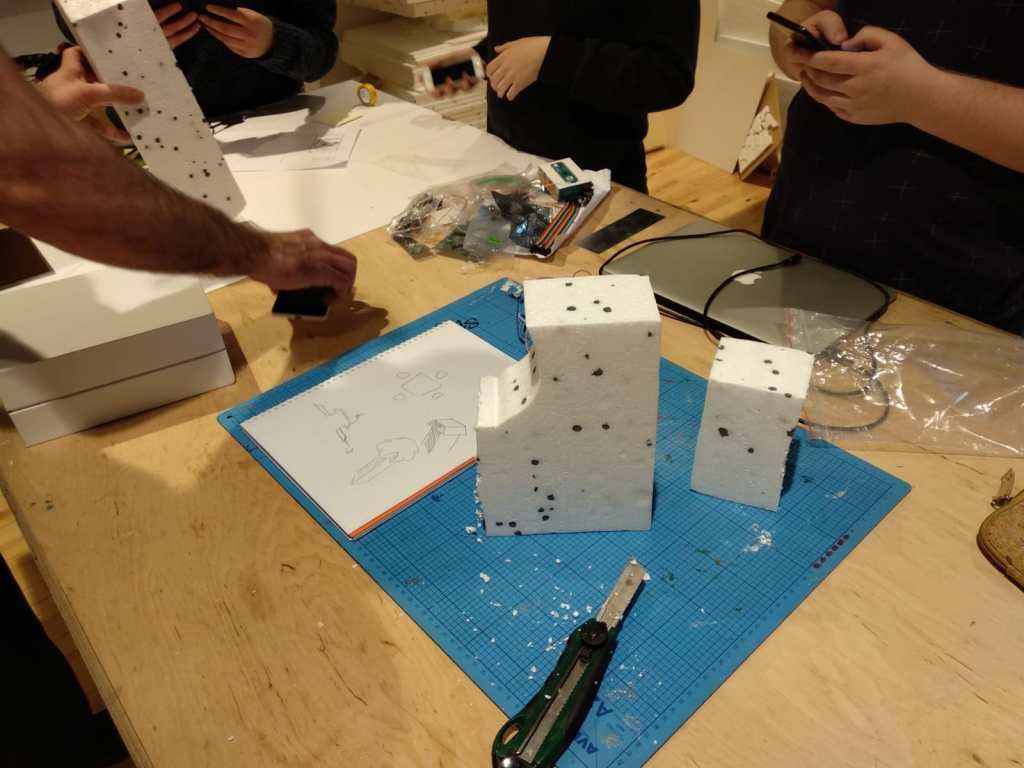
Carving the Styrofoam 
Joystick piece done 
Joystick attached to four buttons
Entry Eight – Arduino Workshop Part Two
Today I wanted to stay home.
I was still not over yesterday, I was angry and frustrated at the end of the class, to the point where I felt that going to finish the project was going to be useless.
«It will still fail to work», «we are way behind the others», «we will not make it», all repeating on my head over and over again as I sat on the bus on my way to the class.
I did not want to go, but I have people there, my teammates, who expect me to attend and try my best, not to get a good grade, but to try and finish what we started.
The task was now to use the results from the previous class to further develop the game we played, and of course, it was a low punch on me. We had nothing from the previous class other than many separate pieces that did not work.
Anyway, we were all already there, what can we lose from trying again?
We got back t work and making the code do the job. And to our surprise, fifteen minutes in, and we found a way to work with the Arduino. We had many limitations, but it was something. My team and I were excited, we were going to make it work this time.
Without wasting a single second we split the tasks and got hands to work again.
Many changes had to be done in order to make it in time; we had to use a different game, as the computer that could run it did not work properly with the code, we also had to simplify the controls in order to adapt the ones we had done on the previous class to this new game.
I got so caught up by work that I did not want to eat nor rest. But when I finally sat down to relax for a few minutes I noticed that, not only me, but everybody on the team were smiling. And with ten minutes left on the clock we were done. We had made a functional game that many found fun to play.
We wanted to make the player feel as if they were really playing the game, we wanted them to engage with the experience. So when the idea came of using a two-player soccer game in which you literally had to kick in order to kick the ball, we all agreed that it was a great idea. Even when some of us did not like football at all.
Both with feedback from our peers and teacher we reached the conclusion that not only was the fact that we make the players use parts of their bodies that are often not used when playing video games that made it fun, but the fact that we gave them a sense of competition similar to the real soccer as well.
By the end of the day we tested other games as well in order to give our peers feedback too. And we also had to patch the game’s controller a few times, as we had little time to focus on them today and they were not as strong as we expected, resulting in parts of them breaking and needing to be fixed.
But the most important part of it was that I got what I had wanted from the previous class, to fail and learn, to succeed in the end and to get something out of the class to apply in the future, and I did.
I realized that sometimes things will not go as planned, and it may not be your fault that they don’t. But it is up to you to put in the effort to make them work. And that it IS your fault if you decide not to do it.

New setup (Joysticks now work with 2 buttons) 
Testing kick buttons 
Complete setup (Joysticks, jump buttons and kick buttons) 
Jump buttons 
Kick buttons 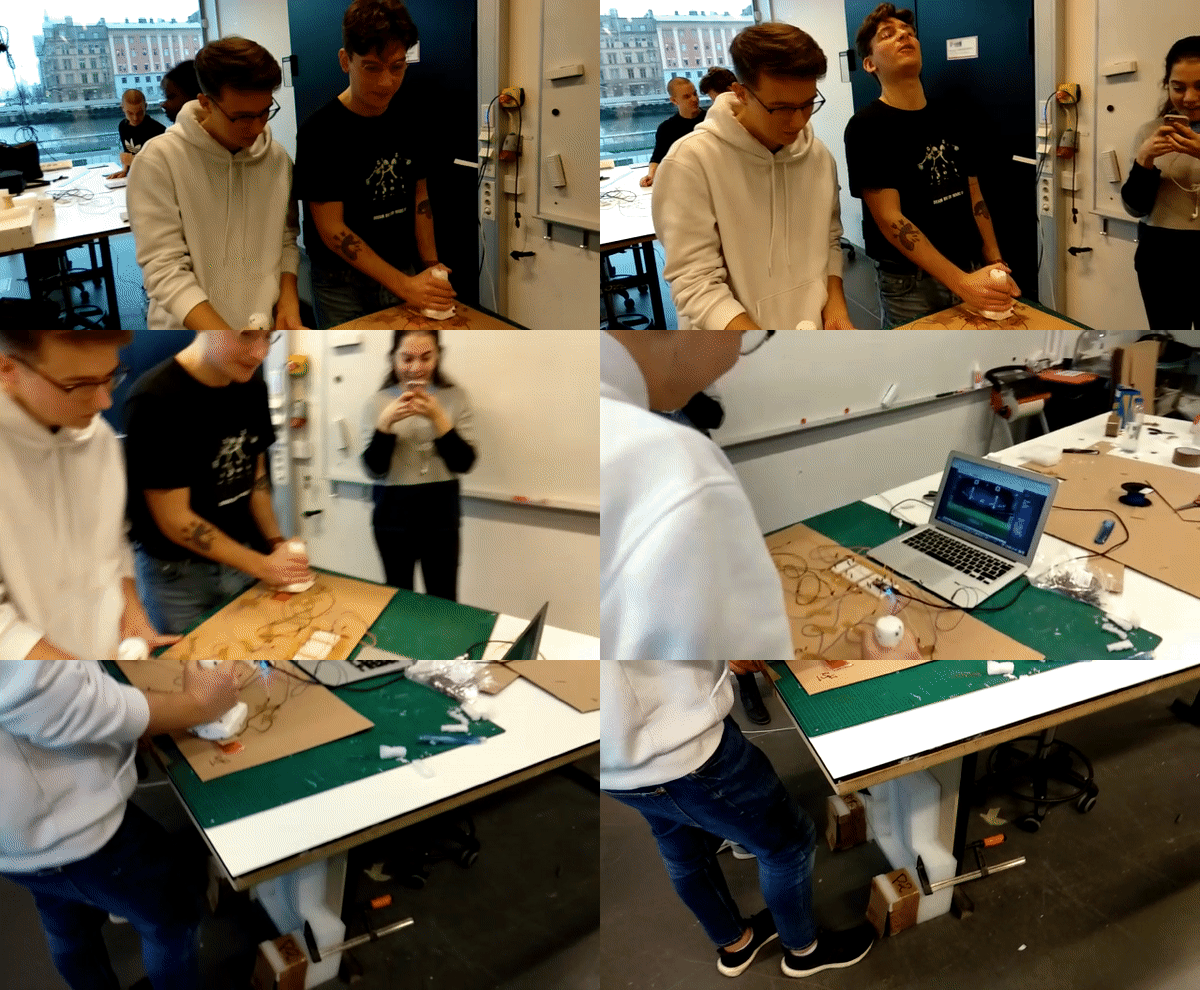
Testing group #1 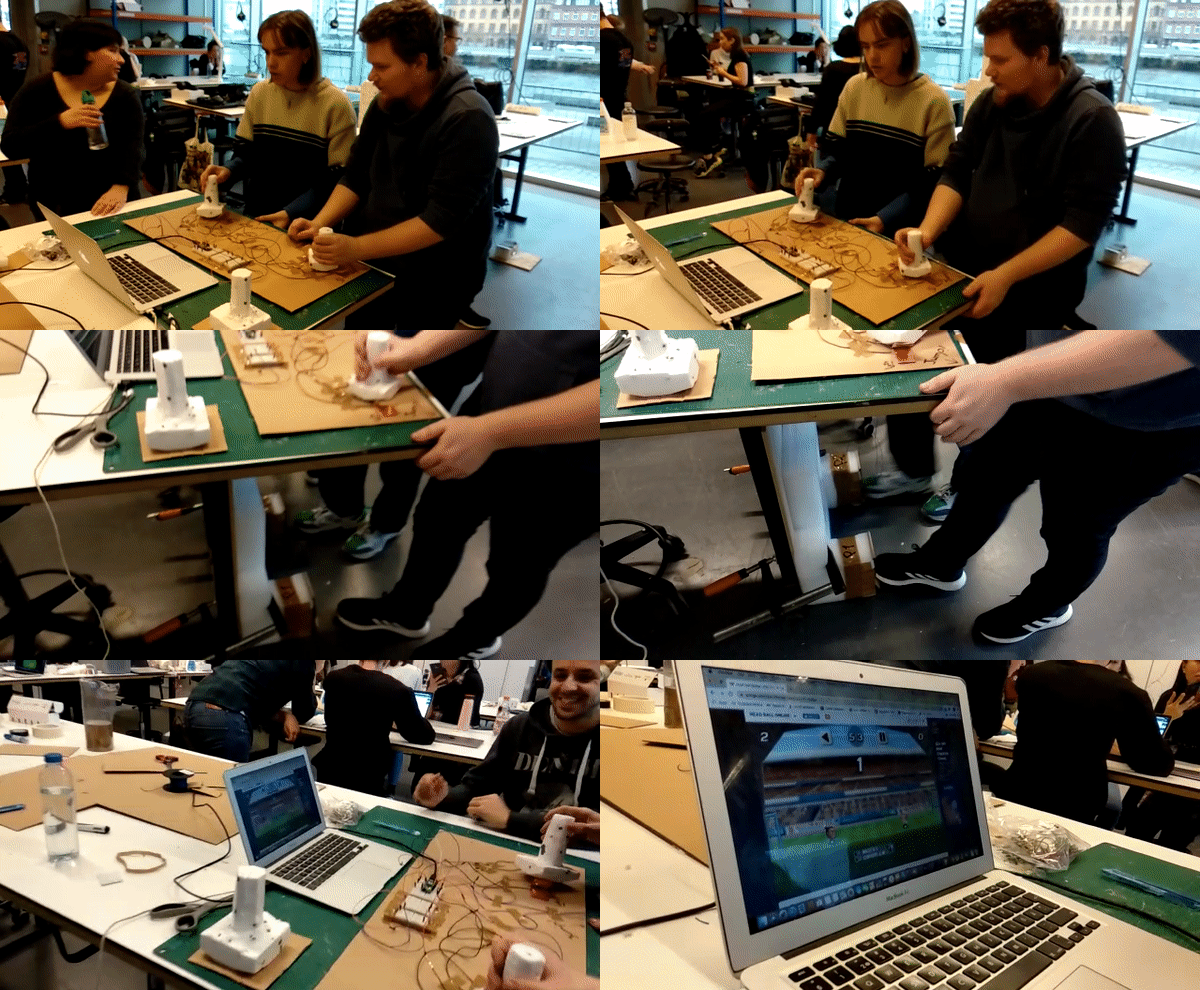
Testing group #2 
Testing group #3
Entry Nine – A Week-Long Project
Today the class was presenting a project that we had all worked on in teams for the entirety of the week. I am writing this on the presentation day to wrap up the overall experience of this project.
Our task did not seem complicated at first. We were given a word to work with, we had to analyze and comprehend this word to then have it as the main focus of the design we will present. The word given to us was «Calming».
It was not until we stopped to think about what calming is that we saw that it will not be easy to make something out of it in such a short time.
We brainstormed for about one hour, by asking ourselves questions such as «How does calming look like?» and «How does it feel to be calm or in a calming place?». This gave us many keywords we would use both for our design opportunities and our research field.
For our research field we asked ourselves the opposite of the previous questions, to find out what is NOT calming instead, and find a conflicting space to explore.
After many hours of throwing ideas into the table we decided to work inside queues, or the action of waiting in line. We defined it to be a place where a bunch of our keywords seemed to match (crowded, loud, anxious, stressful, the uncertain).
To explore this environment we had to experiment it ourselves and with help of our peers, as time did not allow us to run experiments on other people like we did in previous projects. And out of several experiments and concepts we decided to further develop one, which was the chance to know in advance the time that the user will spend on that queue. The objective being to make the user feel as calm and comfortable as possible. Some of the keywords we gathered before that we applied here were (stillness, pointless activities, control, silence).
To further test this we ran two experiments:
The first one aimed to give the user their queuing time in advance, like if they booked it beforehand, so that they can do their activities alongside waiting in the line, so that part of the waiting time is instead used to fulfill their task, and after they are done they know exactly the amount of time remaining, and in this way they can decide how to make use it, be it rather waiting for it to be over or continuing with the previous task in order to improve the results.
The second one tried to compare two different people in the same environment, in which they had to wait for the same amount of time to be done, but only one of them is aware of how much. The point of it was to see if the one person that knows the amount of time they should wait is calmer than the other one, who does not know.
In both cases the results were as expected, the users that were not aware of their queuing time were much more active and anxious than the others. They described the situation as stressing, where the ones who were aware of the time they will be there felt completely different. They just sat down, looking at the timer at times, waiting for it to be over. Where as the others looked up at the ceiling, the walls and the floor, looking for something to entertain them while they waited.
With this statements we presented our ideas, results and conclusions to the class. Much to my surprise the teacher liked the presentation, even when I thought it should have been a bit more fleshed out to be interesting.
During the process we got stuck at moments and struggled to find a way to progress in the project, but by the end of the day we managed to finish the project.
I felt like I did not learn much in terms of the project but I did learn more on how to communicate better with my teammates and my peers. Considering the short amount of time we had I felt as if I had almost no time to bond with them in order to gain their trust, but it was not the case at all, we did a great job at communicating and splitting the work in a way we all felt comfortable with.

Brainstorming #1 (Calming concepts) 
Brainstorming #2 (Analysis and concept maps) 
Brainstorming #3 (More analysis and concept maps) 
Different time displays sketch 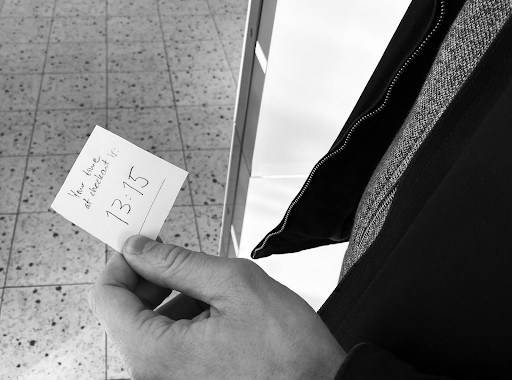
Experiment #1 (Time booking) 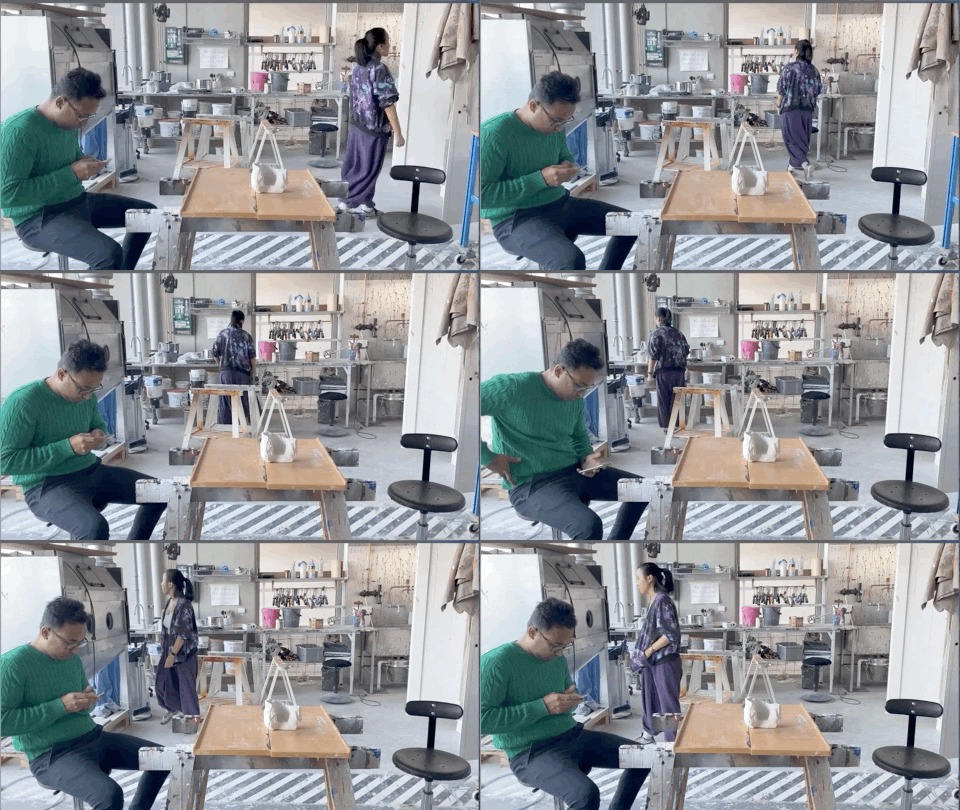
Experiment #2 (Comparison)
Entry Ten – Project 2 / Critique session 1
Today we were presented the last project of the Prototyping class. Our goal is to create a design to enhance communication in an environment.
We were quickly assigned our teams and got straight up to work. My team and I wasted no time in deciding the topic and ended up picking sports, as only a few of us did sports regularly and thought it could be a good idea to pick an environment we were not too used to. And finally, the one thing we must not do is change the experience of the sport, as in not changing it’s rules, it’s flow nor it’s experience, but rather improving the quality of the communication during the activity.
In a matter of hours the team tried to come up with as many questions as we could and then try to answer them.
Which sports are we interested in to work with? How does it work? What are the rules? How do they communicate? How can we improve that?
After a while we had chosen a few sports we believed were good and had found some research on communication in several sports as well. Our pick so far were climbing, swimming, tennis, biking and maybe surfing. And so we began to sketch ideas.
Over a few days we delivered several sketches and possible ideas to each other via Trello and Discord (the platforms we communicates through) and then prepared for the first critique session.
I would be wrong to say we didn’t rush into sketching, which was made clear to us by the teachers during the critique. Even if some ideas were good they had almost no research to back the design decisions at all.
Our task for the next week will be to provide some more data on why this stuff we presented is good and will enhance the communication in said sports.
The sketches were mostly made round the condition that the sport/activity we work with gets your hand busy, so that we need to work with that limitation in mind.
As both the team and I wanted the device to be used by as many people as we could we thought of ways to make it possible to attach it to as many places as we could. So we came up with an idea that was, in short, a small device with a few buttons that could send messages remotely to people that were not practicing the sport, so that they could communicate with family and friends while being on the activity.
My way of making it easy to use it no matter what the sport was by adding several «cases» that you could put the device on, for example, one with Velcro so you can attach it to clothes, or one with elastic straps that can be wrapped around a bike handle.
We will do our best to come up with better stuff for next week, I’m sure something way better can come out of the same concepts.

Elastic bands case and Velcro case 
Velcro Case attached to clothes (chest) 
Velcro case attached to clothes (arm) 
Elastic bands case attached to bike handle
Entry Eleven – Project 2 / Critique session 2
Today we will go a couple of steps back on our previous work and dedicate some days to do research on our chosen sports and the people playing it. Instead of just sticking to articles and personal experience we wanted to put some ground under our sketches and later prototypes. At first we did not give research a lot of importance since we were expected to be in the workshop for long hours working on several designs, but it would be much better if we can back up what we present with more data than before.
We splitted the group in order to cover as many of the chosen sports as we could. We went to gyms, recreation clubs, friends and family that were active at those sports and also some more online research, for those things that we had no place to do research in or that would take too much time.
Towards the end of the week we had some interesting research questions answered by many different people on many different sports. This helped us narrow out area of research greatly since we were going to focus on the ones that had more interesting problems to work. So we started to work on biking, climbing and diving (a new one we came across with).
A bigger brainstorming came next, we needed to see what are we communicating in this sports, and since we will no longer communicate to the people outside of the sport, but the ones that are with you at it instead, we will need a way to both send and receive messages with the device.
Unfortunately I could not attend the critique session this time but my teammates helped me catch up and see what we could improve on the design. We had done a great job with the interviews and research in general, but we were now challenged to provoke the designs and communication more. The design we had was similar to the first one in looks, but we wanted this one to be detachable so that depending on how you will hold it or where you will attach it to the shape can be different for better reach and comfort in situations where hands are busy. It should light up the buttons when you receive a message so that you know what the other people are saying to you. But we were asked many questions on how it works and if we tried how it feels. So we have a challenge to improve the designs and we know exactly where to focus on.
Brainstorming
(communication)
Detachable device concept sketch Detachable device
(assembled + size)Detachable device
(side view)Detachable device
(quick prototype)Detachable device
(quick prototype)Detachable device
(removable parts test)Detachable device
(removable parts test)
Entry Twelve – Project 2 / Critique session 3 and COVID-19
Today we started to sketch again, we have done some designs already and will work on many more. We still do a bit of research whenever we can in order to add as many things as we find useful from it. The sketches were now much more focused on the reception of the messages and the way we display them on the device. We are still a bit unsure if using pictures on the buttons will help since people did not want to get their eyes out of their activity in many of the scenarios we are working with (biking and diving).
So far we imagine the same type of device being used in both sports but each should have it’s own different messages to fit the situation the user is in as well as different ways to hold it onto you. And so we took the two initial ideas we had back in the first two weeks. Instead of making the device detachable to fit different uses we want it to be reprogramable, so that in this way you can set the messages you will need to send and place them wherever you want them on the device. And in order for it to be worn underwater when diving and on the bicycle when biking we used the idea of the different «cases» but with two different models for the device, which work the same but allow for different uses, one will be a waterproof watch and the other will have a connection part on the back so you can attach it to your bicycle. We think adding light to the buttons will help and by now we want to stick to the use of buttons since both research online and interviews to a diving club pointed out that even when knobs are better for underwater use they require a lot of maintenance and they may not want that to be the case on this device, also most underwater devices have large buttons instead of knobs for the same reasons. Keeping it to five buttons maximum is also something we found can help the device not get too complicated nor confusing.
We are now ready for another critique session before jumping into prototyping in the workshop.
During the critique session we were told that a lot of prototypes are expected to be done and that we should immediately start to work on them in order to make it in time for the final critique session next week. We were also given more advice on improvements that can take place on the communication method we used for this device and to try and provoke some troublesome situations among the sport.
We are now working on the first prototype for this design, experimenting with the looks can wait for now as we want to test the feel of the buttons, as it will be important to make sure it gives good feedback when pressed, mostly for underwater users. Once the buttons are tested we will work on a cleaner prototype that we will later improve the looks of. There is still some uncertainty around how we can prototype the communication, but for now we want to make sure we like the main functions in order to bring it to future interviews when looking for feedback.
Finally, talking with both my teammates and some classmates we started to worry about the current state of COVID-19, as many schools and universities have been closing in the last couple of days. We may need to hurry on the production of prototypes and maybe even rush the last round of interviews in case MAU closes as well. Some teams have not even done a single prototype. We will see what happens next week, but for now my team and I want to get at least one good prototype done by next week in order to do some interviews.
Button device
(quick prototype)Button device
(quick prototype)Button device
(unfinished polished prototype)
Messages and communication 
Different button positions and device location (bicycle) Underwater version
(diving)Knob version with push button
(divers)
Joystick version on bicycle handle
Entry Thirteen – Project 2 / Final days and quarantine
Today the entire course received an important announcement. Classes are now suspended on the university as it will be closing down in a few days and we are advised not to show up in there at all from now on. We are now expected to look for different ways to do prototypes, by going digital and prepare for online critique sessions in about a week. We had absolutely no time to finish our prototype as the last entry was finished on a Friday and this one is starting on the next Monday.
The team hasn’t given up of course as we are now working on many different prototyping methods together in groups of 2 or individually. Our previously weekly meeting are now daily and we catch up every morning to see what to do and how to do it. We review each others work and comment on it before continuing to develop stuff. The team worked on 3D models, interface mock-ups, storyboards, and tried to experiment with them as much as possible.
After a few days of polishing the designs the university finally closed down completely and we have been on quarantine since the announcement on Monday. We still kept our previous prototype but it was unfinished and we were unsure about if we could show it on the critique session or not, so we kept it but never really used it afterwards.
The critique session went much better than expected, all teachers gave great feedback (it was the first time we had all three of them at once) and they were very supportive over the situation we were all going through. They explained how the final presentation will go down, what is expected from us and what we should improve from our current designs and material.
The final presentation went down and I feel like in the end we did a great job, there was room for improvement as always but we managed to organize ourselves pretty well and always kept communicating with each other no matter what, something that I bet was due to not only my experience with other teams but my teammates too. The last thing remaining is the final essay and of course, this journal.
We will be on quarantine for a while as I understand it so the next course will be a little weird, but I will try and keep my head up, maybe it ends up better than I expect it to.
High fidelity sketch for buttons device
(by Isak)High fidelity mock-up 3D model
(by Sara)High fidelity mock-up 3D model
(by Sara)
Color messages and request system layout Functionality showcase
(by Isak)
Entry Fourteen – Individual Essay (Semester 2 END)
Engaging with others while prototyping
When prototyping it has always been important to engage with people. Be it for user testing, for further feedback, looking for general opinion, it has always been a useful method throughout the course to involve people in your project and to get involved in other people’s prototyping process. But why is it so useful to engage with others when you prototype? Can you engage with anyone if you want to or do you need someone with specific qualities or standards? How do you know who to engage with to further develop your prototypes?
In this essay I will reflect on the various thought processes I developed during the last projects in the prototyping course as well as try to answer the previously mentioned questions and what came out of them.
Most of the time I found myself wondering not about if I should engage with other but instead I wondered about who I should engage with. Many factors play an important role in your decision, such as the type of prototype, type of design or the public it is aimed towards. You, as a designer, would want to engage with people that will suit your project. Depending on if you are willing to test your design on others the people chosen can vary enormously, from across different ages, different sexes, different sizes or even different tastes. This was made very clear to me on an experiment I was invited to participate in during one of the classes, in which two students were locked in a room for several minutes while pretending they had a romantic date. In here they would run several different tasks depending on how awkward each one felt and this gave them better results than if they invited anyone without considering who they are and as a result give them the same task as someone completely different.
The real challenge to us was knowing who to engage with every time we had to face a new problem or had to answer a question. And so depending or what kind of feedback we wanted we engaged with different individuals. The people my teammates and I would present our designs to would vary depending on what we look for. We present it to other classmates looking for opinions from people with similar tasks that may have found interesting information that can be useful or give advice about similar mistakes; to teachers if we want an honest and unbiased opinion with critique and both positive and negative feedback from a professional perspective; and from strangers or people outside of the project in order to get opinions or responses from the ones that have little to no idea about the project and our expectations or on the other side, people that perfectly know and care about the topic we are handling and can give feedback regarding that specific topic because of their experience and knowledge on said topic.
Engaging with this kind of people, that have a lot of understanding, experience and passion over a topic is precisely what my team and I did on the last project on the course. By reaching into a team of experienced divers we not only got better understanding on what it is to be underwater with a group of people with little ways to communicate and a lot of limitations on how one can get their message across a group in a situation like that, but also we understood what makes for good communication and what would take them out of their activity comfort on a design for communication.
Our results would have definitely improved drastically if we had the opportunity to develop this idea with the diver club more than we did, as they provided valuable information for what is better for them in a functional level, an economical level, a practical level and a comfort level, giving us much more than what we could have acquired by asking people with little knowledge on the sport and definitely better than limiting our research to online data or personal appreciation, since the best statements were given by the more experienced interviewees.
This is why the more we investigated and interviewed we made the most drastic changes on our design on the functional aspects rather than the visual and aesthetic aspects of the prototypes we developed. Like Lim, Y.-K., Stolterman, E., and Tenenberg, J. mention in “Anatomy of prototypes”: “When exploring a certain aspect of an idea, designers can focus on demonstrating various ideas for interaction techniques without determining other qualities of the design, just as its appearance or its functionality”.
As our goal was changing towards satisfying the needs for communication the experienced divers were making us aware of and not the amount of affordances it had. From the beginning to the end all prototypes can be described simply as a device with 5 buttons to send messages. However, the messages being sent were simplistic and generally applicable to any sport at the beginning but very defined and specific towards the end of the prototyping sessions. There was no need to add more stuff to make it solve more issues but instead it needed refining to better suit the divers and better improve their situation when communicating underwater.
Just as mentioned by Lim, Y.-K., Stolterman, E., and Tenenberg, J. “A design idea that satisfies all the identified requirements does not guarantee that it is the best design since a number of ways can meet each requirement. If the focus of prototyping is framing and exploring a design space, what matters is not identifying or satisfying requirements using prototypes but finding the manifestation that in its simplest form, filters the qualities in which designers are interested, without distorting the understanding of the whole”. I wanted this to be present throughout our prototypes, as one of our tasks was not to change or ruin the experience of the sport we work with but instead enhance what is already present in the overall experience said sport.
In order to better engage with the people we disposed of during the length of the project we tried having in mind the kinds of activities that Buchneau and Suri mention in “Experience Prototyping”, which were “Understanding existing user experiences and context”, “Exploring and evaluating design ideas” and “Communicating ideas to an audience”.
We followed this activities so that we could give an order to who we engaged with depending on the needed feedback. Starting up with attempting to understand the existing user experiences and context; we looked for people with great understanding in our topic to then ask them several questions regarding said topic and find what exactly is part of the user experience in their environment. Once we had enough to work with we proceeded to explore and evaluate the design ideas we could come up with, refining them with the previously acquired information and statements, to finally engage with our teachers by attempting to communicate our idea to them, which would give us the professional feedback we lack from the first group of people we would engage with. In this order we managed to optimize production and the quality of the prototypes.
By following this rules we were able to create a circular progression that would retroactively power itself throughout each research interview, to the brainstorming and prototyping sessions, to the critique sessions with the teachers.
If instead we were to start ideating before trying to engage with an experienced user on the field we would have come across many obstacles that were not present due to the previously mentioned research.
The conclusions I was able to reach by the end of the course were, for starters, the great importance of organizing the different processes the design must go through before becoming a prototype according to the type of engagement the designers are looking forwards to. Secondly, the need to define the group of people needed for the design research before trying to engage with them, knowing which person can better help you in each different field you work in will greatly increase the quality of the results and pace of work. And finally the importance of actually engaging with users in itself, be it professional designers that can give advice with the prototyping process itself, experts on the topic you are interested in, or people with unbiased regular opinions that can help you see what the common eye will see on said prototypes. Any kind of engagement with other people will provide useful insights to your work, the challenge lays on finding out what you need the most, where and how to apply it.
References:
- Lim, Y.-K., Stolterman, E., and Tenenberg, J. 2008. The anatomy of prototypes: Prototypes as filters, prototypes as manifestations of design ideas. ACM Trans. Computer Human Interaction. 15,2, Article 7 (July 2008).
- Buchenau, M., and Suri, J.-F. 2000. Experience Prototyping. The Embarcadero. Designing interactive systems: processes, practices, methods and techniques. 424,433 (August 2000).
 Agustin Guerrero's Interaction Design Reflective Journal